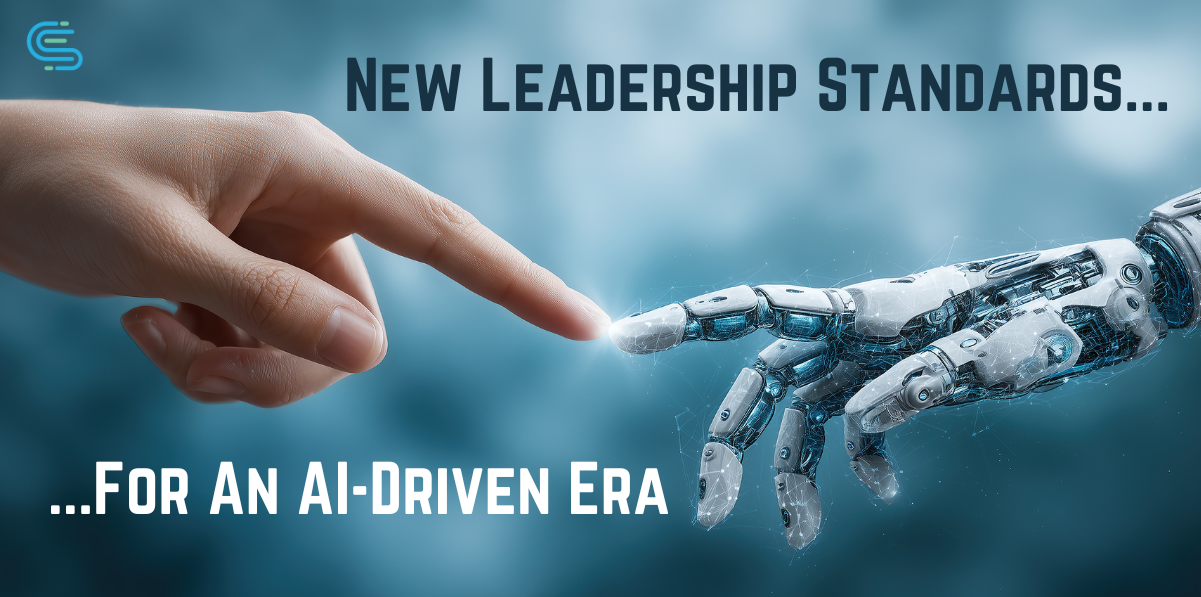
New Leadership Standards For An AI-Driven Era
Developing Future-Ready Leaders
The future of work is a fluid, constantly evolving target. As AI reshapes how work gets done, leadership skills are changing just as quickly. Static job descriptions, linear career paths, and traditional workforce planning models just can’t keep pace with intelligent machines and digital labor.
Harvard Business Impact research highlights a “nonlinear evolution of roles,” saying traditional workforce planning models are ill-equipped to meet the complexity of AI-driven change. While much of their research focuses on skills and technology, a surprising challenge is emerging beneath the surface: role ambiguity.
In other words, when roles lose clarity, leaders often do too.

The Hidden Risk of Nonlinear Role Change
Traditionally, roles have served as anchors. They defined expectations, career paths, and even measures of success. But AI is reshaping work in unpredictable ways, and now those anchors are weakening. In fact, leadership roles themselves are shifting, not towards clear-cut “next versions” but toward undefined states where responsibilities shift constantly, at the risk of leaving titles and org charts behind.
This perpetual shift creates a new leadership challenge: leaders aren’t just expected to manage change; they must do so without clear role definitions and parameters. A tall (and vague) order!
Traditional Leadership Pipelines Are Buckling!
Nonlinear role evolution doesn’t just affect current leaders; it disrupts how future leaders are developed. As AI automates and reshapes entry-level and foundational roles (think processing invoices, managing calendars, or handling initial customer inquiries), organizations risk losing the hands-on experiences and the learning-curve that traditionally helped future leaders develop critical-thinking skills.

Today, AI isn’t just assisting employees; it’s running full processes like onboarding workflows, supply chain tracking, and routine decision-making. As a result, expectations for leaders have changed.
The leaders of tomorrow are increasingly valued for abilities like interpreting people signals, guiding AI-enabled systems, and providing strategic clarity in uncertain environments. These are skills that can’t be replaced by AI.
In a fluid, AI-driven workplace, clarity is the muscle leaders flex to help their teams make sense of change as it unfolds. Future-ready leaders:
- Understand the purpose and impact of new environments
- Recognize when teams are experiencing excessive change
- Strategically adjust workloads and competing priorities
- Create psychological safety where questions and concerns can be voiced
By reinforcing new ways of working through consistent support and follow-through, these leaders create stability and trust even as roles continue to evolve.
AI Without Role-Clarity Creates Friction
AI adoption is already widespread. Data from Harvard Business Impact shows:
- 78% of leaders report significant or extensive AI integration into their daily workflows.
- Yet only 36% of leaders feel confident in their understanding of basic AI, data analytics, and cybersecurity concepts.
This gap matters, not because leaders need to be technical experts, but because AI changes what leaders are responsible for. As machines take on more execution, leaders are expected to provide context, ethical judgment, and direction, often without clear role definitions to guide them.
Leading Through Ambiguity, Not Just Change
Savvy organizations know that the future of work isn’t just fast, it’s fluid. Roles will continue to shift, overlap, and evolve in unpredictable ways. Successful leaders are those with the skills to guide teams in times of uncertainty.

This is where ChangeSync’s approach to future-ready change leadership steps in! In today’s state of stacked, overlapping change, leaders need the skills to recognize change fatigue, normalize resistance, and help teams adapt without staying stuck in crisis mode. Through our TRANSFORM Leadership Framework®, people-leaders build practical, repeatable skills to navigate this reality, including:
- Identifying and addressing change fatigue early, before it erodes trust and performance
- Understanding how people move through behavioral change, to mitigate resistance before it escalates
- Creating psychological safety, even when answers are still evolving
- Reinforcing new skills and behaviors over time, so change is sustained and integrated long-term
Rather than treating change as a one-time event, we teach leaders to build change capability and resilience into everyday work.
Bringing It All Together: Future-Ready Leaders
Today’s state of constantly shifting workplace demands ties directly to ChangeSync's TRANSFORM Framework®, a strategic seminar designed to give your leaders the practical change leadership principles, skills, and tools to lead their teams effectively through ambiguity, evolving roles, and AI-driven transformation.

At ChangeSync, we’ve seen organizations succeed not because their leaders had all the answers, but because they were prepared to lead with transparency, adaptability, and trust, even when the path forward wasn’t fully mapped.